
Why is that art in its various forms has declined in our modern age? For some this question may itself be a non-starter, for they don’t perceive any decline but rather a proliferation of forms that one can choose from. Nothing is really better or worse than any other, it all comes down to the conformity between the artist’s way of expression and the viewer’s taste. Often what a work of art lacks in aesthetic or technical refinement is compensated for by the “story” behind the art and the artist; it is not the work of art itself but the interpretation, its “deeper” meaning that counts. This can be taken to an extreme form of subjectivity – solipsism – whereby the value of a work of an art is judged merely by the effect it has on an individual – any individual – whatever may be its “objective” merits, or lack thereof. This sentiment is best demonstrated in the following clip from the Marvel TV Show “Daredevil”:
The popularity of this opinion is due to the fact that it has more than a grain of truth in it, for art relies primarily on the feeling that an artist wishes to communicate through its medium to have an effect on its audience. Thus, art is primarily a means of self-expression, and its aesthetic or technical merits are in service of this aim, and not aims in themselves. That is to say, a bottle of water may be perfectly painted, but it won’t generate any feeling in us, unless there is some accompanying context that adds meaning to the fact of its depiction; the “why” of the bottle being painted takes precedence over the “how”.
The “why”, then, is the main thing, and it has more to it than simply the intent of the artist. There is a social meaning, a shared understanding, of every idea that one wishes to communicate. If the meaning of a work of art is our main criterion for assessing its value, a shared understanding of this meaning makes it easier to devise a standard for what is “good” art. On the other hand, the more individualistic and subjective our understanding of ideas becomes, the more arcane becomes our assessment of an artwork’s merit, making one individual’s judgment incomprehensible to another. The consequence is that people end up either shrugging their shoulders and say “hey, if you like it, sure, why not”, or justifying an artwork on values that shouldn’t belong to the art itself, such as its function as social commentary or as the output of a misunderstood genius.
It is not deniable that our understanding and appreciation of art now is highly subjective, and there is no standard for what is considered “good” art. Perhaps the one criteria that is universally accepted is how “avant-garde” art is, i.e., to what degree it incorporates innovation and use of new technology, and how radical it is in implicit or explicit social commentary. These being the predominant ideals of our present age, it is unsurprising that popular art, by its very nature, embodies and expresses them in its various forms – be it music, painting, or literature. This also gives rise to the counter-movement, i.e., an appreciation for the “old” simply for being in opposition to the “new”, but again these merits have nothing to do with the art or the intent of the artist, but rather result from the value superficially imposed on them by our present ideals.
So, how is it that I can say that art has declined in our modern age? On one hand, it is my opinion. On the other, I point to some objective factors, such as the absence of any great artist of the standard of those that were recognized in the past, the obvious decline in skill and care in the creation of these works, the dilution of the definition of art itself to cover anything that stands for some kind of mastery or self-expression (e.g. Donald Trump’s “Art of the Deal”), etc. But these objective factors themselves depend on a common agreement of what art should be, which as I have already mentioned above, can not be taken for granted in our day and age. Putting it in other terms, the value judgment that art has declined is a “prior”; if we don’t share this judgment, then anything proceeding from this will be incomprehensible. However, I encourage you to stay with me, for I believe there will be something of interest for you anyway.
I recently finished reading the biography of Jean-Francois Millet, the famous 19th-century French painter of peasant life. He was a major source of inspiration for Vincent Van Gogh who copied several of his famous works in the late stages of his life, including The Sower and The Reaper, and was perhaps the most acclaimed French painter at the end of his life. Millet was one of the “founders” of the Barbizon school of painters, who rebelled against the existing conventions of art in France by dedicating themselves to the painting of subjects taken directly from nature. This was in opposition to the formalist school that continued the tradition of depicting classical forms which these new artists found empty of authentic meaning and self-expression, and in Millet’s case, morally degrading.
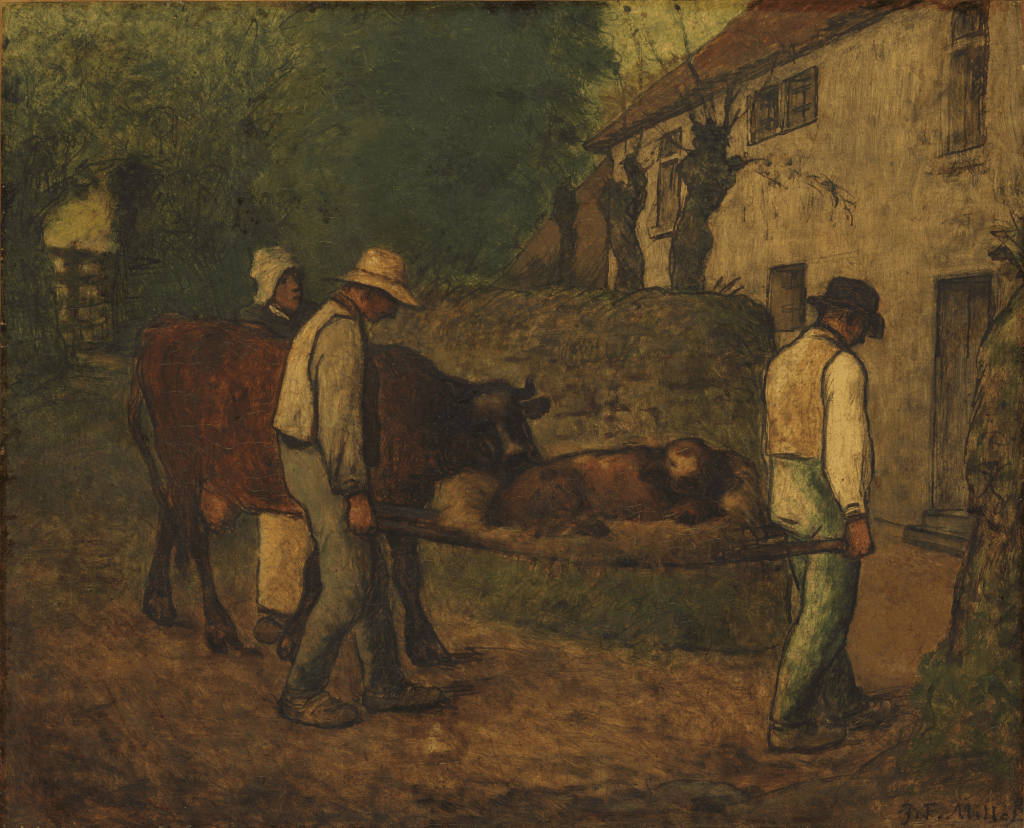
Millet and his fellow artists (Theodore Rosseau, Jean-François Daubigny, etc.) faced an uphill struggle in obtaining recognition for their renditions of nature and its objects, and were in constant battle with the established authorities on art at the time, especially the Paris Salon – the primary exhibition of art in the world. While Millet’s talent was universally recognized, he was castigated for his choice of subjects consisting of plain-looking peasants going about their daily life and labors. The artist himself was a Christian and family man, and sought to embody in his art what he believed to be the fundamental truth of his life:
My programme is work. That is the natural condition of humanity. “In the sweat of the brow thou shalt eat bread” was written centuries ago. The destiny of man is immutable, it can never change.
Millet struggled all his life to establish that beauty consisted in the essence of an emotion, not its outward form. He refused to make his peasants classically beautiful, for he believed that such an embellishment would be degrading to the ideal he wished to express: the act of earning one’s bread from one’s labour, perfectly embodied in the work of the peasants he knew so well, having himself been one. For this he suffered penury and rejection almost his whole life; the authorities did not take kindly to what they saw as an implicit critique of their way of life, that too in art, which was meant to express the highest form of human activity, to which they obviously felt entitled.
Does that sound familiar? The dissenting reader, who has followed me so far, will now exclaim: “Aha! Here you have contradicted yourself and fallen into your own trap. You criticize modern art because it promotes subjective feeling over objective “quality”, but you’re championing Millet, who struggled for the same purpose, that of establishing authentic emotion in its rightful place above aesthetics. Modern art is just the logical conclusion of this project. How then can you accept Millet and reject the art of today?”
To this I respond: the quality of Millet’s art, and the meaningfulness of his struggle, depended on the quality of his ideal, and his ideal was a higher truth than the one he found currently prevailing. It was his moral sense that dictated his choice of subject, and it was this moral sense that recoiled from the ideals that pervaded the art world of his time. And it was precisely this moral sense, and his steadfast refusal to compromise on it, that stood in the way of even basic comfort and financial security for himself and his family, let alone well-deserved fame and recognition.
Millet also did not have the benefit of making avant-garde political critique or social commentary through his art. He refuted the label of Socialist at a time of great political tension in France. It was, in fact, due to his suspected political tendencies that his art was rejected out of hand for so long in spite of its universally acknowledged technical merits. This was to his immense chagrin and despair; he protested strongly against such political interpretations, not because they impaired his art’s value, but because they denigrated the principle he was committed to.
In spite of all this, Millet finally gained his rightful spot in the pantheon of artists because his ideal won out against the established dogma as the greater truth in a world that was growing weary of the hypocrisy and emptiness of the ruling classes and their ideas. The falseness of the old ideals became apparent in the art that it produced, and in the twilight of the idols was ordained the dawn of a new set of beliefs, which the art of Millet and the Barbizon school had anticipated.

I take the example of Millet because it exemplifies the relationship between the quality of art and our ideals. When our commonly-held ideals reflect our innermost truths about life, art achieves its apotheosis. In the era of the Old Masters, art was in service to the religious and aristocratic way of life, and thus the art of Titian, Michelangelo, David, was sublime in both its subject matter and execution. As times changed, the patronizing classes were cut off from the vitality of the people, and the ruling ideas no longer reflected the truth of the people’s existence, their hopes and dreams. The true religious and moral ideas still existed but found no true representation in art – morality and religion here meaning the present understanding of man’s relationship to the infinite, in Tolstoy’s words. The conscientious artist had to turn inwards and find his true calling, and since this still had an authentic and moral underpinning, there was social meaning to the art he produced, a relationship to reality, to the true feelings of the people.
This however, was a slippery slope, and once the artist had discovered in nature a higher moral ideal, the question became: what next? As the lives of the people were being transformed by industrialization and the accompanying philosophies of Rationalism and the Enlightenment, the scope of ideals shrank rapidly to the inner mysticism of man as individual, as both religion and nature lost their idealistic potential. They ceased to be the source of man’s highest hopes and deepest fears; the arena for the battle of his soul’s destiny shifted inwards. And here, with Van Gogh (it is my suspicion, although it bears further research), art acquired its truly modern feature: subjectivism and interpretation, the inner life of the artist overshadowing the external form of the art work.
Van Gogh was perhaps the last of the sincere artists, but his extreme sincerity destroyed the last remaining vestiges of shared idealism, in a movement similar to how Nietzsche described nihilism as the outcome of Christianity’s search for truth taken to its unintended logical conclusion. Van Gogh appeals to that part of us that wishes to see the world as he did, as a place where the mystery of existence can still unfold in the midst of all this rationalism and empiricism that empties it of any higher meaning. It is indeed a form of escapism, an introspective existentialism that has become the dominant mode of thought for those of us who can no longer honestly return to the religious and natural ideals of old.

I used to wonder how art took this turn in a time which is putatively the most liberal and permissive that has ever existed, where an increasing number of individuals have the chance to pursue their calling in this field and exhibit their talent. From my reading and research, I have realized that the same thing that enables this progress is what hinders the quality of the art. Man has always needed an ideal , even though he has mostly been unable to achieve it. Hitherto man felt himself incapable of his ideal, and so it was not the ideal that was at fault but man himself. In art, man expressed his longing for this ideal, and perhaps also an unspoken suffering from being unable to achieve it. Now we live in a time where the ideal is considered unworthy of man, or at most secondary to his own comfort and enjoyment of the material world. The effect that this inversion has had on art, the highest form of our activity, is plain to see for those who have eyes.
Fast forward to today, and this individual introspection has reached a point where even the external form of the art doesn’t matter as long as there is an accompanying text or story that links it, however tenuously, to the artist’s intent. While we appreciate Van Gogh’s technical mastery, we no longer consider it necessary to elicit the same feelings of existential awe. This is an indictment not only of the state of our art and our standards for it, but most importantly, of the state of our ideals. We have none, except perhaps a faith in technological and political progress as the highest form of human experience. What matters now is not the depth of feeling but the smartness of interpretation and exposition; the painting of a Campbell soup can in different colors acquires the same (perhaps greater) value as a Millet simply because it appeals to our own preference for impotent analysis over actual life. When our only options are an external subject that elicits an ironical intellectual response or an internal subject that is a bottomless pit of emo navel-gazing, is it any surprise that our art lacks the beauty, feeling, and care that only originate from a deeply-cherished ideal?
 Sanchit Creates
Leave a reply to Notes on Idealism – Part One – Sanchit Creates Cancel reply