It was one evening a few months ago, while returning home from a tennis lesson, that I witnessed a scene that forever confirmed my unhappy sentiments about modern Indian life.
Waiting at a traffic signal, I saw two men on a motorcycle being followed closely by a horse – not in itself a remarkable sight in our country. After a few seconds I realized that the horse was being towed behind the motorcycle with a rope held by the pillion. It was rush hour at this busy intersection; dust was blowing in the warm dusky wind; various forms of incompatible transport – bicycles, rickshaws, motorcycles, cars – were jostling each other to beat the signal and avoid craters in the road. In this madness, tiresome even for those of us being chauffeured in air-conditioned cars, the poor horse was pulled hither tither by the motorcycle swerving around obstacles to overtake traffic, its legs unable to maintain a natural pace. In the background stood massive glass offices of multinational corporations, facades gleaming serenely from reflections of the warm orange rays of the setting sun.
At another time and place, I might have seen all this without forming an impression of it; indeed spending enough time in India inevitably expands one’s definition of normality to encompass the bizarre. But this time, owing either to my own heightened sensitivity or the objective contrast of this scene, I could not help being absorbed by it. My absorption culminated in depression once I thought through the meaning of it all as it appeared to me.
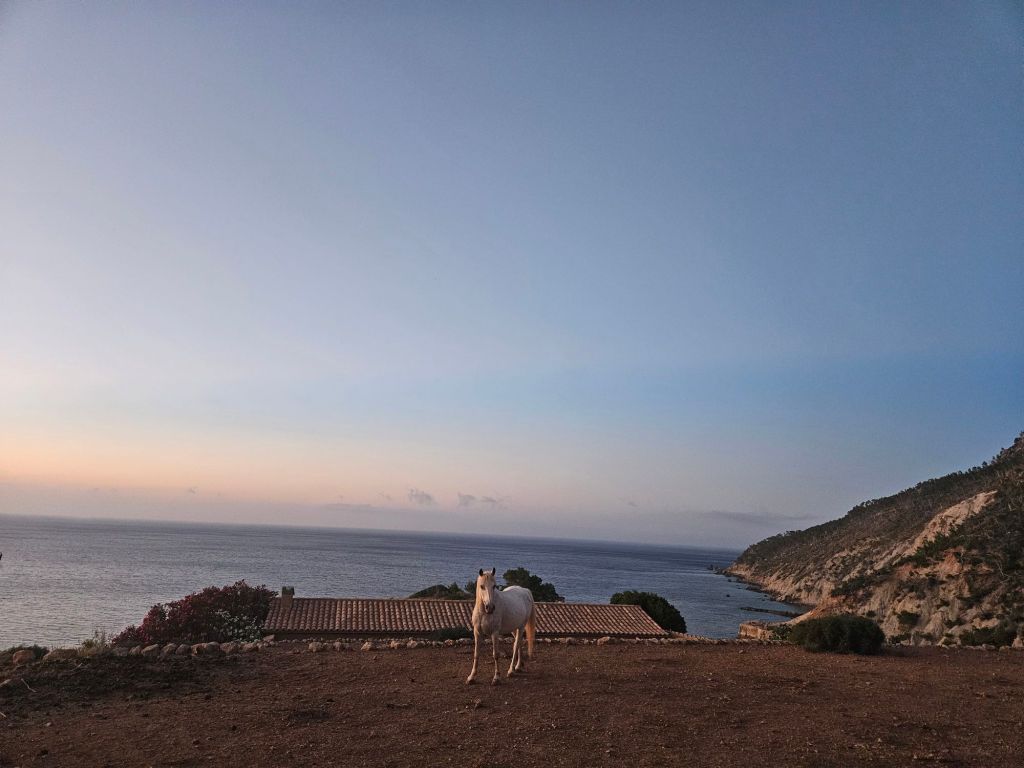
The horse was white, the kind ridden by the groom to the wedding altar in a procession of relatives dancing to the tunes of a band. This procession, called “baaraat”, is the wedding’s highlight. The groom wears the costume of a medieval Indian prince, including a bright turban, and sometimes carries a ceremonial sword. It makes for a ridiculous scene: imagine an out-of-shape office worker or business owner, who last rode a horse as a child on a carousel, in an ill-fitting prince costume astride a sickly malnourished horse who would collapse within ten feet were his rider to take him for a gallop. Yet, this objectively comical and outmoded phenomenon remains the staple of Indian weddings to this day, the organization of which is a massive industry in India.
This was the context of the scene I witnessed: the two men on the motorcycle were taking a wedding horse to a location they were headed themselves. Instead of hiring a pickup truck for two thousand rupees (roughly thirty US dollars), they took the cost-effective route: towing the horse behind their motorcycle, which was going there anyway. Whether they were employees or owners of the business, I do not know. Since this is a rather unremarkable phenomenon for those familiar with Indian business practices, why did it affect me so?
Because upon reflection, this unhappy scene demonstrated to me the enduring immorality of modern India. There was a time in our recent history, perhaps a decade or so ago, when one could have argued that in our poor country such cost-saving methods are an unfortunate necessity for small businesses; that logistics are not sufficiently developed to be accessible to everyone; that in the face of widespread poverty, the decent treatment of animals is unfortunately of secondary importance. None of these arguments, if they ever were genuine, are defensible today.
On a macro level we are considered a global economic super-power; on a micro level, this incident occcured in one of our richest urban centres. Most people in India have a smartphone and many own at least some form of transport like a motorcycle, indicating some discretionary income above subsistence. Besides, this was not the act of a poor farmer driving a bullock cart; it was the decision of a business catering to – at minimum – a middle-class demand. As for logistics, any individual can book anything from compact rickshaws to large container trucks on a smartphone app. We are no longer so poor or deprived of alternatives to not feel ashamed of horses being dragged against their will by a motorcycle through our famously unforgiving urban traffic.
I remember when, as a child growing up in this city, I had the same hopes for economic progress that justified these arguments. We had only to wait for the promise of development to inevitably be fulfilled for our country to become a paradise like Germany and America. Today, we stand at the summit of this mountain we so ached to climb only to realize that it is a precipice beyond which lies an abyss. Some of our citizens are amongst the richest in the world; on our ill-laid streets are driven some of the most expensive vehicles there are. Our leisure classes call upon resources of labour and capital unimaginable by even the most prosperous citizens of the West. And yet, we never have enough economic development, enough education for the lower classes, and enough government regulation for basic decency and civility to take root in our hitherto barren soil.
The road on which this incident occurred is infamous for corrupt traffic policemen, who use every pretext to harass motorists for bribes. Their modus operandi is to hide behind wild bushes on the sidewalk and catch vehicles in unwitting acts of made-up traffic code violations. Flashy SUVs, driven by the city nouveau riche, are a popular target. It is really rather comical. As I passed this signal, I saw a familiar sight: the same policemen pulling over passing vehicles, leaning into each window, haggling with drivers over eye-watering fines. Like monkeys eating a stolen piece of fruit, they scanned their surroundings with unnatural alertness while slipping five hundred rupee notes in their back pockets. As I passed them by, I couldn’t help but catch a final glimpse of the motorcyclists going along their way – without helmets but with a horse in tow – unperturbed and unmolested.
 Sanchit Creates
Leave a comment